On 6 September, Cholud Kassem herself guides visitors through her retrospective Im Schutz des Rituals [The Protection of Ritual] at the Kurpfälzisches Museum in Heidelberg.1 It is a warm late-summer day in Baden. At the same time, a state election is taking place in Saxony-Anhalt; the AfD emerges as the strongest political force with around 44 per cent of the vote. One week later, while finishing this essay, the expanded BRICS group meets in New Delhi, giving visible form to a global order no longer willing to be defined primarily by Europe and the United States. Two very different developments, yet perhaps two sides of the same historical moment: one marked by the return of nationalist politics and warfare, the other by a profound redistribution of global power. It would be misguided to turn either into a political template for reading an exhibition. But art never exists outside its present. Terms such as protection and belonging, foreignness and identity, veiling and visibility acquire a different resonance when inherited distinctions between centre and margin, the universal and the particular, those who define and those who are defined, are being profoundly reshaped.
Perhaps one of the strengths of Kassem’s work lies precisely in allowing this field of resonance without submitting to it. Her subject is older, more elemental, and at the same time more complicated.
The retrospective Im Schutz des Rituals, on view at the Kurpfälzisches Museum from 1 August to 13 September 2026, offers the first opportunity to see some thirty-five years of artistic work in a large constellation. More than 200 objects are assembled: paintings, collages, works on paper, video and ceramics. What becomes visible is the way forms and materials migrate through the oeuvre, changing surface, scale and meaning as they go.
Born in Baghdad in 1956, Kassem came to Germany with her Iraqi family at the age of three. After her mother returned to Iraq, she first lived with German foster parents in Viernheim, was raised Catholic and baptised under another name; later she spent periods in children’s homes run by nuns. After vocational training, she studied German, geography and art at Heidelberg University of Education [Pädagogische Hochschule] and has worked as an independent artist in Heidelberg since 1997.
The following chronological outline builds on Julia Behrens’s catalogue essay and the studio conversations with Cholud Kassem documented there.2 What follows is less a linear survey of individual series than an attempt to trace how forms return, migrate and are transformed across Kassem’s work.
The early Tagebuchblätter [Diary Sheets] of the late 1980s and early 1990s already establish a tension that will remain central to Kassem’s work: the image appears as something provisionally held together rather than permanently secured. Forms emerge, are interrupted, covered and reconsidered. What matters here is not simply their instability, but the repeated act of giving instability a form. Already at this stage, making an image becomes a negotiation between exposure and protection, appearance and withdrawal.
The image does not emerge as the execution of a fixed idea. It develops through revision, resistance and return – a process that will become fundamental to Kassem’s later work.
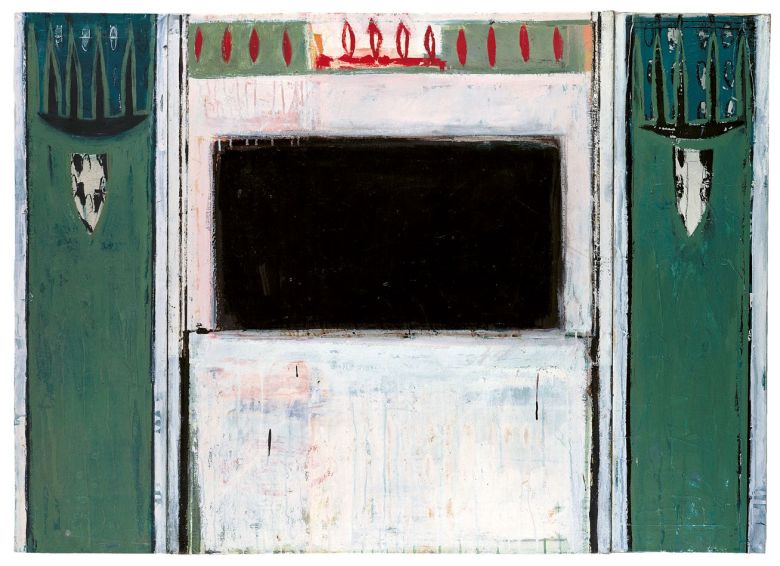
With the 1993 triptych Die weise Wache heilt [The Wise Guard Heals], this search assumes a surprisingly self-contained form. Geometric symmetry, serrations, shield- or heraldic-like structures on the side panels, and the dark rectangle at the centre already contain a vocabulary of forms that will recur decades later. In the Heidelberg catalogue, Julia Behrens aptly describes the work as a kind of “prospectus” for what is to come. Yet its closure is deceptive: the symmetry is handmade, the trace of the hand remains visible, and the apparently stable image bears the marks of its making.
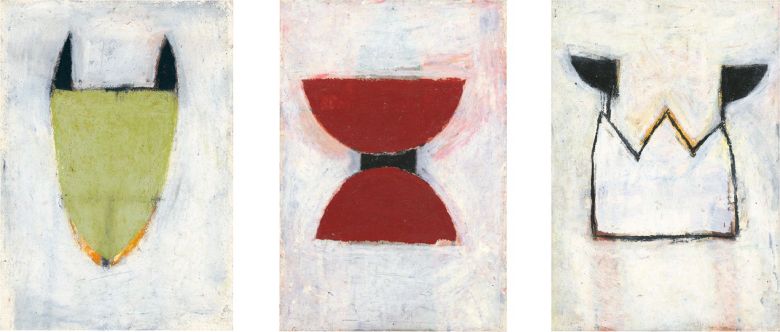
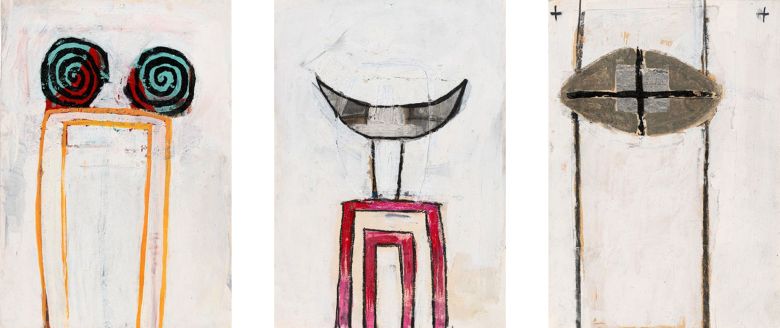
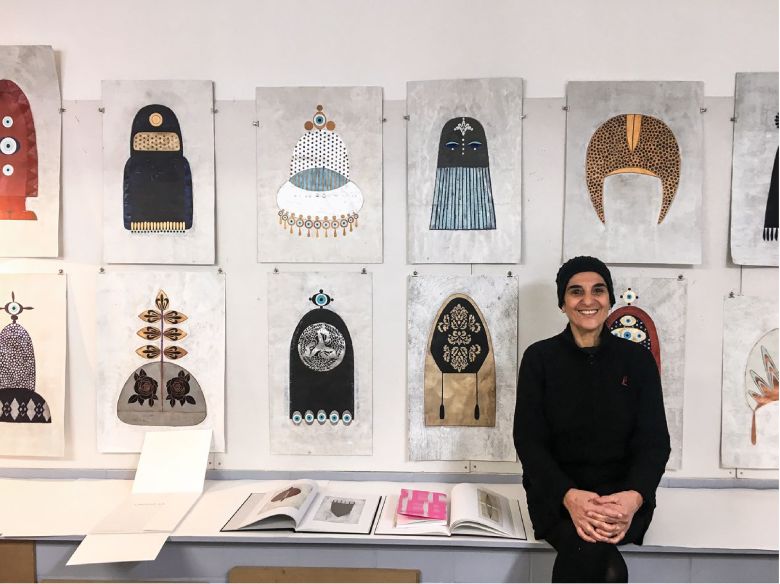
With the Schutzlinge [Protective Beings] of 1995 to 2000, the question of protection acquires a recognisable pictorial body. The forms suggest figures, shields or masks without settling into any one identity. Their meaning remains suspended between object and body, defence and exposure. This resistance to complete identification is important: the Schutzling protects not only by forming a boundary, but also by refusing to become entirely legible. Kassem’s repeated processes of applying, removing and reworking material reinforce this ambiguity. A form is never simply placed on the surface once and for all; it emerges through successive decisions. The image therefore retains the history of its own transformations.
Even here, “protection” is double-edged. The compact forms appear defensive, yet they bristle with points and serrations; they are protective and potentially aggressive at once. The shield refers to the attack from which it is meant to protect. Protection contains threat as its negative precondition.
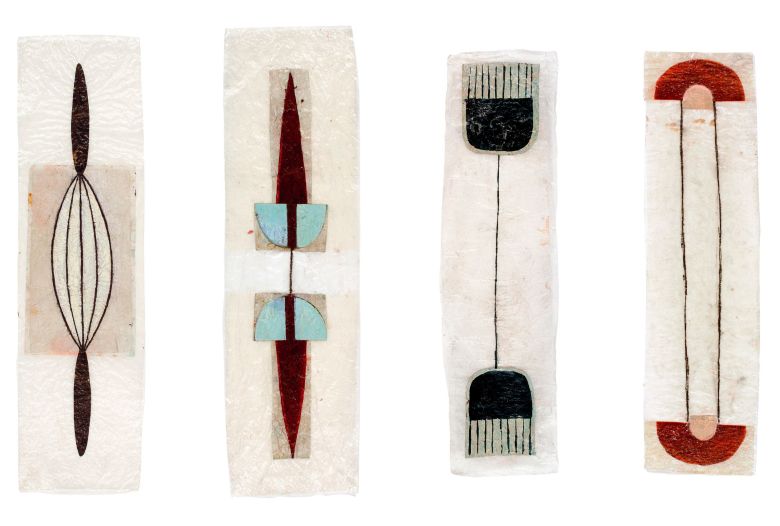
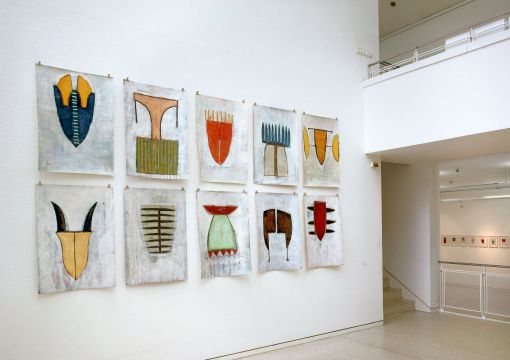
In the Pfeile [Arrows] of 2002 to 2005, this ambivalence becomes more overt. Tracing paper is collaged and compacted; many arrows have a point at both ends. What at first promises direction loses precisely that certainty. The distinction between attacker and attacked begins to waver. The image sustains the contradiction rather than resolving it.
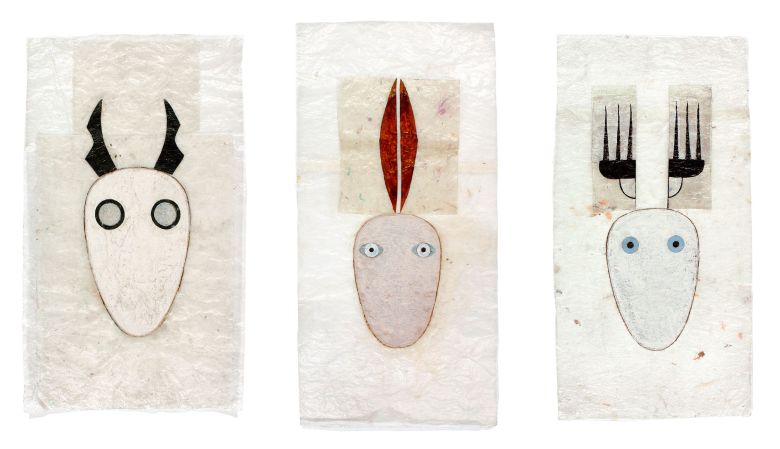
With the Wudus of 2004 to 2007, the ambiguous bodies of the earlier works move closer to the face. Yet these faces never become portraits. They remain constructed signs: part mask, part body, part imagined being. This shift is crucial because it intensifies the relation between surface and identity. The image begins to resemble a body while continuing to resist the demand that this body disclose who – or what – it is. Here protection becomes inseparable from legibility. A face normally promises recognition; Kassem’s faces withhold precisely that certainty. They allow the viewer to recognise a bodily presence without granting complete access to it.
In Fühler und Geweihe [Feelers and Antlers] of 2008/09, elements familiar from the earlier groups of works reappear in altered form. Such transitions matter more to the argument developed here than any linear periodisation: one group of works does not replace the one before it, but transforms elements already present within it.
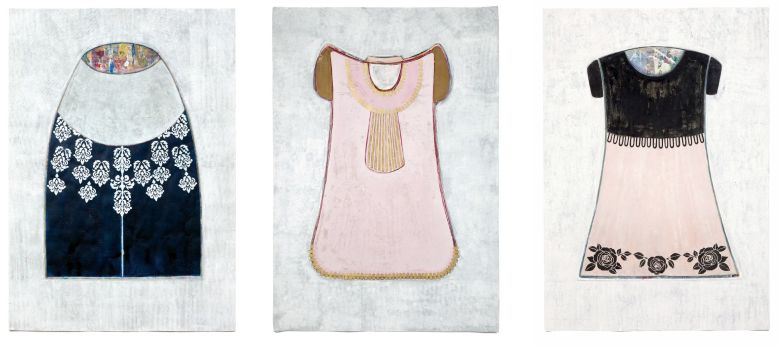
From 2010 onwards, the pictorial world changes. In … es sei denn, was außen ist [Unless What Is Outside], garments and dresses move to the foreground. Some recall liturgical robes; others derive from Kassem’s own First Communion dress or the Sunday dresses of her childhood. For the first time, her Catholic socialisation explicitly enters the pictorial material. Kassem recalls that, as a child, the rituals of regular church attendance gave her a sense of “safety and security”.3
The garment is more than a carrier of memory: it is a second skin. It covers the body, gives it a social form, and makes visible the community to which that body might be assigned. The boundary between inside and outside is not stabilised by this; it becomes a problem in the first place. Behrens notes that the necklines of some garments open onto a more unsettled, mottled interior: ornamental order outside, unrest within. How much covering does a body need in order to show itself?4
In 2014, this question shifts biographically. An uncle in Turkey contacts Kassem; after more than four decades she meets her mother and members of her Iraqi family again. During later meetings in Elâzığ she is warmly received, yet repeatedly questioned about her position on religion and Islam. This experience does not amount to a “return” to a lost cultural identity; rather, it expands and destabilises an identity that already exists.
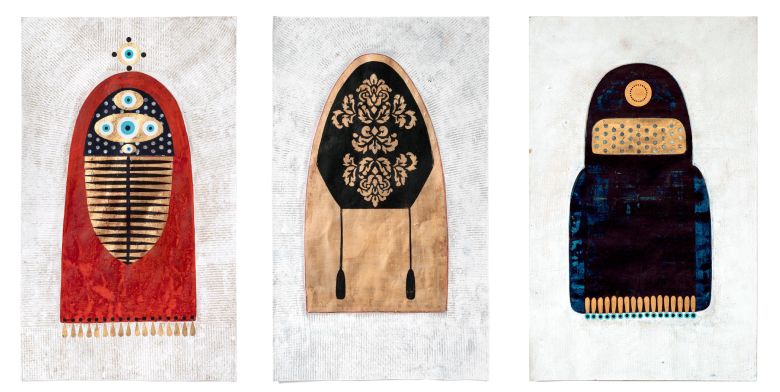
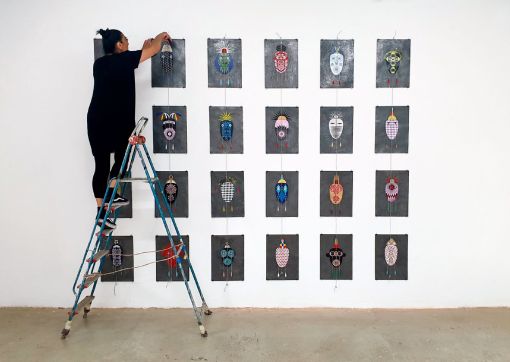
In Schutz- und Tarnhelme I und II [Protective and Camouflage Helmets I and II], made between 2015 and 2018, earlier forms from the Schutzlinge and garments combine with new ornamental elements, among them stencils acquired in Istanbul and the so-called Eye of Fatima. Here in particular, it would be tempting to construct a simple narrative: first the German, Christian childhood, then the renewed encounter with the “Orient”. But the new forms do not overwrite the old ones. They are added to them, altering their legibility while being altered by them in turn.
Kassem describes the internal connection between her groups of works more directly – and more bodily: “I stand behind the Schutzlinge, I fight with the Pfeile, and I wrap myself in the cloaks. Finally, I put on the protective and camouflage helmets.” Rituals, she adds, are a basic human need in dealing with threats.5
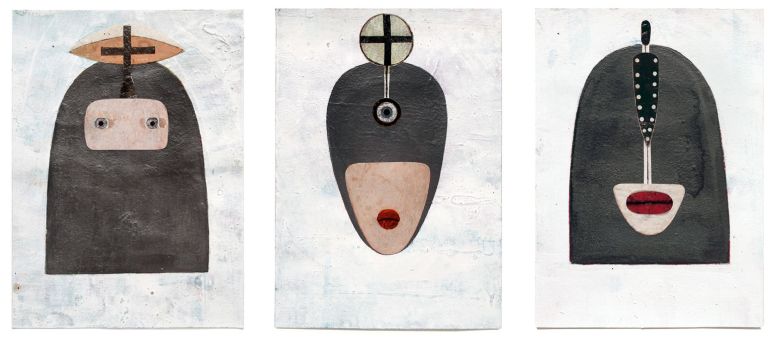
Burka Hidschab Nonnenschleier [Burqa Hijab Nun’s Veil] of 2018 brings different traditions of bodily covering into a deliberately compressed pictorial space. Christian and Islamic references appear beside one another without being resolved into a common symbolic language. The works do not ask the viewer simply to identify one veil as Christian and another as Muslim; rather, they expose the act of identification itself. How quickly does a head covering become a cultural sign, and what assumptions accompany that recognition? The later installation extends this question from the individual image into a spatial constellation of religious, domestic and biographical references. What had previously appeared as pictorial boundary now becomes an environment in which different cultural registers meet without becoming identical.
Veiling is always also a politics of the body. Who is permitted to see a body? Who decides what becomes visible, what marks belonging, and when concealment itself can become a form of self-determination? Postcolonial feminist theory has warned against a double reduction: the female body can indeed be regulated within religious or patriarchal orders; at the same time, a Western gaze risks constructing “the Muslim woman”, or the so-called “Third World Woman”, as a homogeneous figure of oppression.6 Seeing is itself always part of social relations of power. A gaze does not merely register what lies before it; through learned categories, expectations and hierarchies, it also helps produce what appears as visible, foreign, female or available.7
The point is less to retrospectively assign Kassem to a feminist programme than to acknowledge that her work touches on specifically female experiences of body, covering, gaze and cultural attribution. Her images of veiling undermine the simple equation “visible = free” and “hidden = oppressed”. What matters instead is that visibility itself is socially regulated and that, in Kassem’s work, the body almost always appears through mediation.8
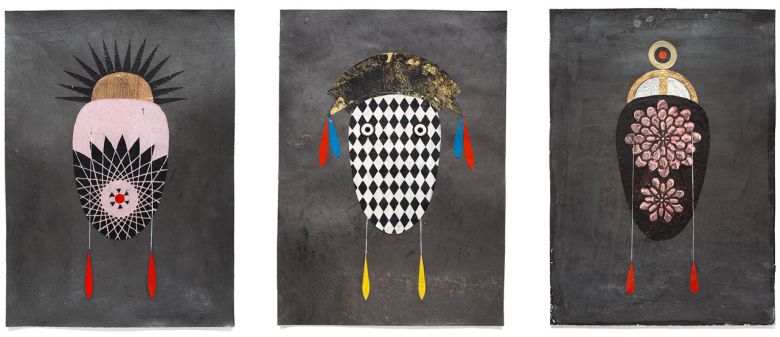
In the Weeping Pillows of 2020 to 2023, created during the pandemic, vulnerability becomes more immediate. The anthracite graphite ground of Burka Hidschab Nonnenschleier remains; face-like forms from the Wudus merge with the ornament of the camouflage helmets, while small eyes release long lines of tears. Protection is still present – as pillow, ornamental covering, face-like form – but it no longer fully contains vulnerability. Tears pass through the protective form.
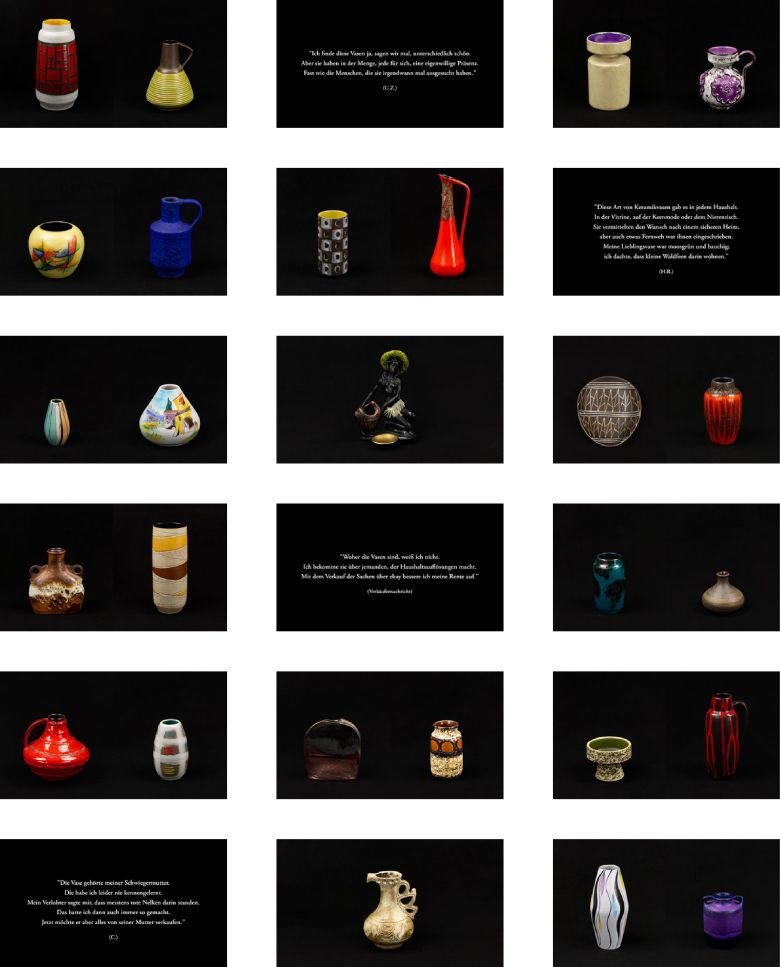
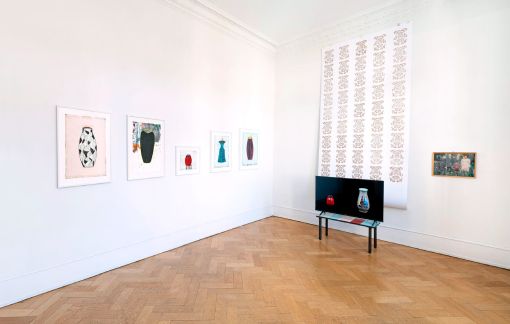
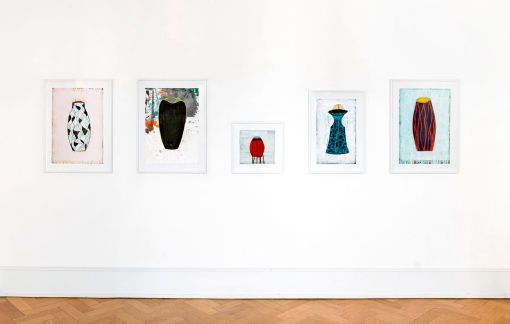
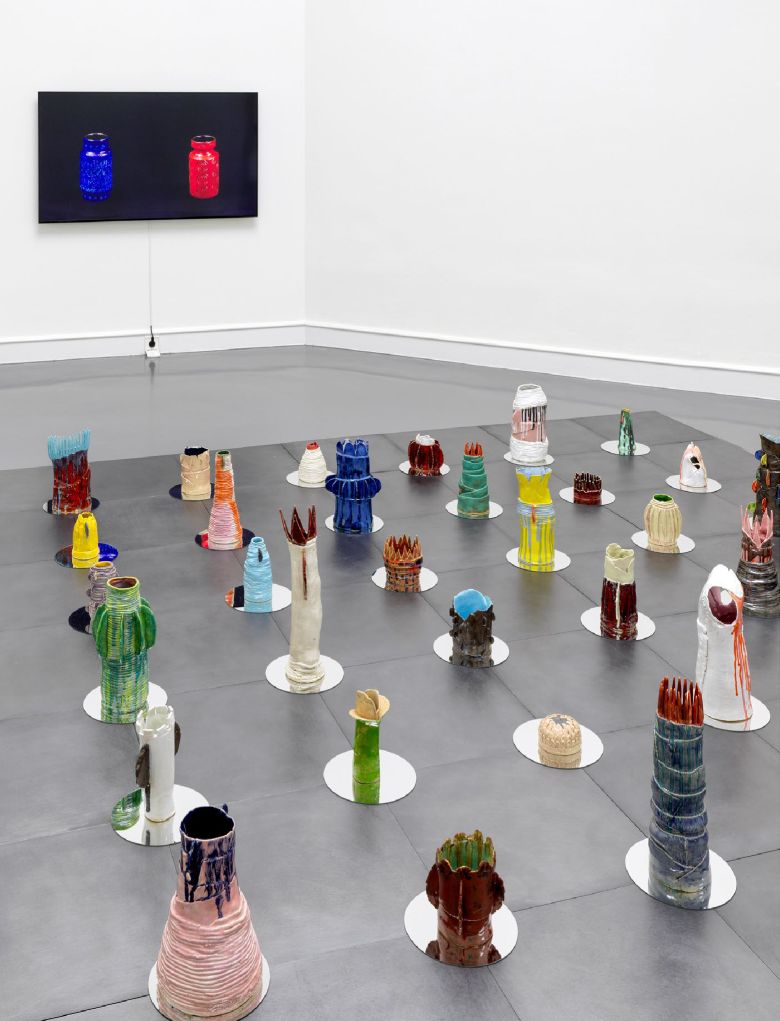
At almost the same time, Kassem begins collecting West German domestic ceramics from the 1950s to the 1970s. For West German Pottery, she asks former owners about their memories of the vases. A serially produced decorative object thus becomes a carrier of different life stories. From this research emerge the painted Erinnerungsspeicher [Memory Containers], later the Vasenheiten – oder – Heldinnen des Alltags [Vase-Beings – or – Heroines of Everyday Life], and finally the ceramic Trutzburgen I und II [Fortresses I and II].
In the Vasenheiten, the vessel almost becomes a person; it acquires a physiognomy. At the same time, the title Heldinnen des Alltags evokes a gendered history: the everyday vessel, historically associated with household, care and decoration, gains a presence of its own. The thirty-six Trutzburgen take this anthropomorphisation further: they can be plant, body, vessel and architecture at once, open and protected, receptive and repellent.
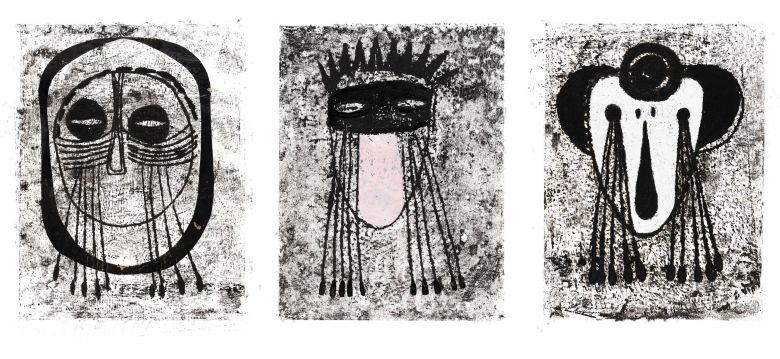
Julia Behrens has described this shift as an opening of the previously protected interior and as a dissolution of the longstanding separation between inside and outside. Kassem herself speaks of seeking a “deeper expression for the painful things in life”. Rather than treating this as the final revelation of an inner truth, however, I would read it as another transformation within the work: protection does not disappear; its boundaries are renegotiated.9 This makes it impossible to treat “protection” as an immutable key to Kassem’s work. A protective system can itself become a boundary – and a boundary can be opened.
This is where the exhibition’s interpretative challenge begins. Aby Warburg (1866–1929) was a German-Jewish art historian whose work fundamentally changed the way images are understood: not as fixed signs, but as forms that travel across time, cultures and contexts. His interest in the afterlife of images and in the persistence of gestures and symbols provides an important point of reference for the questions raised here. Warburg’s lecture, delivered in Kreuzlingen in 1923 and later widely known as the “Serpent Ritual”, emerged from a particular existential situation in the life of the art and cultural historian. From 1921, Warburg was undergoing psychiatric treatment with Ludwig Binswanger at the Bellevue Sanatorium. His renewed engagement with the journey through the American Southwest he had made almost thirty years earlier, the ordering of memories and images, and finally the preparation of the lecture were part of the process through which Warburg gradually regained psychological stability.10
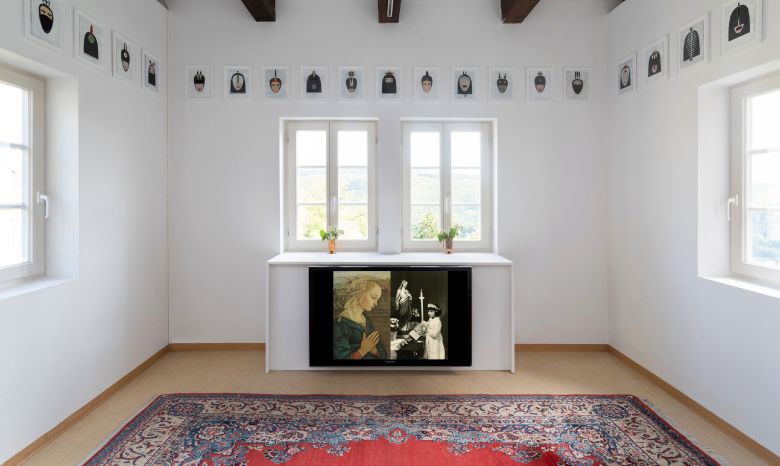
This context of its making adds another layer to his thinking on ritual and symbol. When Warburg describes human beings as placing symbolic forms between themselves and a world experienced as disordered or threatening, distance is more than an art-theoretical category. It names the possibility of giving overwhelming experience a form in which the world can be perceived, remembered and shaped. In the English version published in 1939 as “A Lecture on Serpent Ritual”, the text speaks of the human being who places “symbols between himself and the world”.
Kassem’s works should not be made to illustrate a theory a hundred years older than they are. Yet Warburg’s lecture is useful precisely where the symbol appears not simply as a substitute for something absent, but as a means of producing distance. The mask does not eliminate the gaze; the helmet does not make the body invulnerable; the garment does not end the relation between inside and outside. Warburg’s Denkraum can therefore be understood as culturally produced distance: between stimulus and response, fear and action, body and outside world, the symbolic form intervenes. Denkraum is not, for Warburg, an abstract mental location, but a distance created through cultural forms. Only when symbolic mediation enters between immediate impression and response does that space emerge in which perception can become reflection.11
Here Warburg’s thinking converges with Cassirer’s. For Ernst Cassirer, symbolic forms are not mere representations of a world already given; through language, myth, religion, science and art, the world is first ordered and made experienceable.12 Cassirer’s Philosophy of Symbolic Forms can serve as a compass when thinking about different cultural worldviews.13 Applied to Kassem, this means that an image does not merely represent protection; it symbolically produces the very relation between body, boundary and threat through which protection becomes experienceable.
Warburg’s observation that “magic and labour coexist” is productive here as well. Magical and rational action need not be understood as two historical stages; ritual can be understood as an embodied form of knowledge – through repetition, gesture, temporal order and practice. Against the background of the lecture’s Kreuzlingen genesis, this thought acquires a further dimension: ritual and symbolic form do not abolish threat, but create distance from it. They give affect a form and experience a temporal structure.
When Warburg writes that the calm form of ritual draws its energy from the “depths of human passion”, Kassem’s formal rigour also becomes differently legible.14 The controlled Schutzlinge, the aggressive Pfeile and the grieving Weeping Pillows show how form does not eliminate affect but binds it. Repetition, layering, overpainting and the decades-long recurrence of particular forms can, in this sense, also be understood as aesthetic procedures of stabilisation: not as the immobilisation of vulnerability, but as a way of living with it.15
Another part of Warburg’s work also proves fruitful for the Heidelberg exhibition: the unfinished Mnemosyne picture atlas. From the late 1920s onwards, Warburg arranged photographs of works of art on black panels alongside advertisements, press images, ancient representations and astrological diagrams. What mattered was not the isolated origin of an image, but what adjacency could make visible: recurrence, displacement and difference. The atlas is therefore less an archive than an experimental arrangement of seeing.
Sigrid Weigel has insisted that Mnemosyne should not be treated as a closed system of symbolic meanings. Memory is not a repository of unchanged images; images return in constellation and transformation. The Warburg-Weigel line of thought thus offers a more precise alternative to older notions of archetypes or “primordial images”.16
Nothing simply returns in Kassem’s work. The point of the Schutzling can become an arrow, the arrow a horn or antler; the facial oval of the Wudus encounters the camouflage helmet, and helmet and cushion merge in the Weeping Pillow. The vessel moves from found carrier of memory to painted memory store, acquires a physiognomy in the Vasenheiten, and finally appears as a ceramic Trutzburg. What recurs is defined by the fact that it changes.
This is one of the retrospective’s central strengths. It brings together works often separated by ten or twenty years and creates new adjacencies: the early image becomes differently legible through the late one, while the late image carries memories of earlier forms. This is precisely why Weigel’s reflections are productive for contemporary art. Mnemosyne opens onto a temporality of the image that is not linear: the present can make the past newly visible. In this sense, the Heidelberg exhibition – without imitating Warburg’s atlas – can be read as a Mnemosyne-like Denkraum.
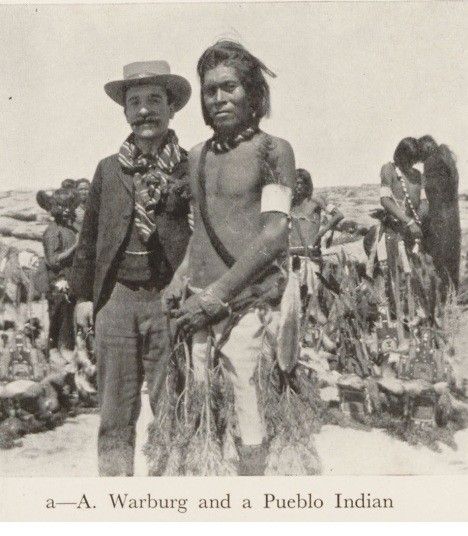
Weigel introduces a second, more critical thought. In her 1995 essay “Aby Warburg’s Schlangenritual: Reading Culture and Reading Written Texts”, she asks not only what Warburg recognised in Pueblo cultures, but how that recognition came about. Warburg has no unmediated access: he does not know the languages, he did not witness the serpent ritual named in the title, and his knowledge is produced through photographs, other observers, memories and cultural analogies. The published text itself reaches us through several stages of manuscript, editing and translation.17
For Weigel, precisely this mediation is itself part of the object. The “Serpent Ritual” is not a text from a single historical moment: decades separate Warburg’s journey of 1895/96, the Kreuzlingen lecture of 1923, its reconstruction from notes and drafts by Fritz Saxl and Gertrud Bing, the English version published in 1939 as “A Lecture on Serpent Ritual” in the Journal of the Warburg Institute, and the German book edition Schlangenritual. Ein Reisebericht, published by Wagenbach in 1988 with an afterword by Ulrich Raulff. The text we read today is therefore itself the result of memory, editing, translation and reworking – a layering in which every return already entails change.18
The question therefore shifts from “What does this symbol mean?” to: under what conditions do we believe that we have grasped its meaning? Kassem’s forms, too, are seen through cultural conditioning: a European viewer encounters ornament and thinks “Orient”, sees a veil and thinks “Islam”, sees horns or mask-like faces and thinks “archaic” or “African mask”. Such recognition tells a history of European seeing as much as it does a history of the work being looked at.
Edward Said’s critique of Orientalism never claimed that cultural difference did not exist. Rather, it showed how the “Orient” became a screen for projection within European culture: spiritual and irrational, sensual and archaic, timeless and exotic – opposed to a West understood as modern and rational.19 Even apparently positive terms such as “original”, “magical”, “archaic” or “Oriental” are therefore not innocent. They can turn cultural difference into an allegedly fixed essence – as though people, images or cultures possessed an immutable core that already explained their meaning. That the opposition between “West” and “East” itself has a history belongs to this critical perspective.20
This also concerns the reception of Kassem’s work. Earlier texts, including those by Hans Gercke, contain precise formal observations and form part of that reception history; at the same time, a language operating with “primordial images”, African masks or an “archaic” pictorial world requires critical scrutiny.21 This becomes particularly striking in Dietmar Schuth’s contribution to the current Heidelberg catalogue. His recollection of the young Kassem as a “foreign-looking beauty”, his description of her as an “Arab” woman, and the suggestion that she later “finally” acknowledged her Arab biography and accepted an identity “between two cultures” exemplify the extent to which perception can already be organised through cultural categories. The new catalogue itself also speaks of the “archaic presence” of the Trutzburgen and an “intensely Oriental visual language”.22 The methodological question, then, is this: what is being observed in the work – and what does the language of observation itself bring into being? A vase may recall ancient vessels without therefore being “archaic”; Kassem’s birth in Baghdad does not retrospectively make her early geometric forms Mesopotamian. Biography is context, not iconography.
Here Stuart Hall takes the argument a step further. One of the defining British cultural theorists of the late twentieth century and a central voice in Cultural Studies, Hall fundamentally shaped debates on representation, diaspora and cultural identity. In his essay “Cultural Identity and Diaspora”, he rejects the idea that cultural identity is a hidden origin merely waiting to be uncovered. Identity appears instead as a historical process of positioning and articulation.23
Kassem’s biographical rupture of 2014 can be understood more precisely in these terms. The renewed encounter with her mother and Iraqi family does not reveal a long-hidden “true” self; it creates a new present from which her own past also becomes differently legible. Origin appears not as an immutable core behind the images, but as something remembered, evaluated and articulated anew.
For the question of how meaning emerges when different experiences, pictorial traditions and social formations meet, Homi K. Bhabha takes us further. The Indian-born literary and cultural theorist is among the most influential voices in postcolonial theory. In The Location of Culture, he develops the concept of the Third Space: not a neutral zone between two already fixed cultures, but a relational site in which meanings are produced through translation, displacement and encounter.24
For Kassem, this idea is productive because it avoids the familiar formula of an existence “between two cultures”. German and Iraqi experience do not appear as two closed spaces between which she must find a place; meaning emerges instead from their relations, overlaps and transformations.
A related perspective can be found in the later writings of the Iranian philosopher Daryush Shayegan. His notions of “patchwork identity” and “nomadic thought” describe cultural identity not as a coherent inheritance rooted in a single origin, but as a mobile constellation of heterogeneous experiences, memories and intellectual traditions. In this sense, identity becomes less a question of belonging between fixed cultures than of moving among different cultural registers without reducing them to a single synthesis.25
This brings the reading back once more to Sigrid Weigel – and directly to mohit.art. At the launch of our platform on 10 December 2021, she spoke under the title “Counteracting Blind Spots on Europe’s Map of the World’s Cultures” about transnational initiatives for exchange, translation and networking. “Blind spots” arise not only from a lack of knowledge about particular regions. They also arise where stereotypical notions of homogeneous cultures turn origin, religion or national belonging too quickly into explanations of artistic production.26
This perspective forms part of what Weigel calls an “epistemology of transitions”. For her, knowledge does not arise within stable boundary lines, but in passages between disciplines, media, cultural transmissions and forms of knowledge. Her reading of Warburg in particular shows that such transitions are never lossless: memory, translation, editing and rereading alter the object they transmit.
For mohit.art, this touches on a programmatic core. Categories such as “Iranian Art”, “Arab Art” or “SWANA Art” may initially open Eurocentric orders and make previously marginalised contexts visible. Yet they can themselves become labels as soon as origin becomes the primary explanation of a work. Geographical and historical contexts should not disappear; the crucial point is to understand them as relations rather than closed identities.
Weigel’s notion of cultural multilingualism offers a productive term for this. What is at stake is not the translatability of a sign from one clearly definable culture into another, but the capacity to perceive different cultural registers at the same time without declaring any one of them the authentic origin. Meanings can coexist, shift and alter one another without being reconciled in a final synthesis.
Here Weigel’s transnational reflections meet both her reading of Mnemosyne and Bhabha’s Third Space: meaning emerges relationally. Ambiguity is not indecision; it is a condition of knowledge.
From here, the question of legibility can be sharpened. Artists with migrant or diasporic experience are often expected to account for origin, religion, conflict, trauma or migration – and the work risks being treated less as art than as evidence of a biography.
Kassem’s works do not refuse such references; particularly in the more recent groups of works, they become explicitly visible. But disclosure is not the same as complete legibility.
Kassem’s semantic openness resists this demand without breaking off communication. It does not mean arbitrariness, but the coexistence of several possible readings, none of which fully displaces the others. Precisely here the works retain a residue of unavailability. Protection thus also concerns the right not to be exhaustively legible.
From this notion of a protected in-between, the conclusion of Warburg’s “Serpent Ritual” acquires an unexpected contemporaneity. There Warburg turns to the technological modernity of his own time: lightning, once mythologised as serpent or divine power, is technically mastered and forced into the electric wire. He does not dispute this progress; yet in the triumph of technological rationality he recognises a new danger.
Warburg describes Franklin and the Wright Brothers as “fateful destroyers of our sense of distance”; “Telegraph and telephone are destroying the cosmos.” The “instantaneous electrical contact” threatens the distance created by mythical and symbolic thinking – and with it a condition of reflection.27 By Augenblicksverknüpfung – instantaneous contact – Warburg means proximity without the necessary distance: a connection that, precisely for that reason, threatens to abolish the Denkraum.
More than a hundred years later, this instantaneous contact has assumed a dimension Warburg could not have foreseen. Digital image worlds combine an immense quantity of visibility with the expectation of immediate reaction: an image appears, is recognised, categorised, commented on and replaced by the next. The time allowed for seeing grows ever shorter.
Kassem’s working process follows a contrary temporality: layers are applied, scraped back and overpainted; forms are set aside, revisited and allowed to return years later in altered form. Ritual can therefore be understood as a technique of delay – not as a return to a premodern order, but as a temporal structure that produces distance. The return to Kreuzlingen gives this thought an existential urgency. For Warburg, distance was not only a theoretical category but part of a struggle against psychic disintegration: the capacity to create symbolic distance between affect and reaction was bound up with the recovery of intellectual and psychological stability.
Yet here Kassem’s most recent series, Tätowiert von Innen, resists any overly closed interpretation. The covering developed over decades becomes permeable; the line grows faster and more forceful, colour gives way to black and white, and the tears lose the ornamental containment they still had in the Weeping Pillows. What had previously been mediated through mask, helmet, garment or vessel moves closer to the surface.
Protection thus proves not to be an end state, but an aesthetic technique for dealing with vulnerability – and precisely because it is a technique, it can be altered, loosened or abandoned. A form of protection that initially made it possible to enter into relation with the world can itself become a limitation.28
From here, the retrospective can once more be read as a whole. It tells neither the story of an artist developing towards an ever more complete “authentic” identity, nor a story in which the later images reveal the hidden meaning of the earlier ones. What becomes visible is an ongoing work of positioning: forms emerge from experience, assert themselves, change in new biographical and historical situations, and retrospectively acquire other meanings. The past remains alive not by preserving what is identical, but through transformation.
This is where the contemporary relevance of Kassem’s work lies. It does not simply represent an artist “between Germany and her migrant background”; rather, it calls the apparent certainty of such assignments into question. Different cultural experiences are neither denied nor fused into a harmonious identity; they remain active as differences and alter one another. The female body, too, is neither a universal “human body” nor merely a bearer of cultural identity, but is situated within histories, social structures and gender relations – visible, yet at the same time withdrawn from complete access.
Here Kassem’s work touches on a central commitment of mohit.art. A transnational art discourse cannot consist in merely replacing Euro-Western categories with new geographical or cultural labels. It must make different histories, experiences and pictorial traditions visible without fixing a work within any one of these affiliations.
Warburg’s Denkraum, Weigel’s epistemology of transitions, Bhabha’s Third Space and Shayegan’s nomadic thought point, in different ways, towards a common premise. Im Schutz des Rituals produces the open space at stake here: between visibility and withdrawal, memory and the present, body and world – and between the image and its appropriation by meaning.
At this point, finally, the name محیط – mohit – can also be understood more precisely. The Arabic word muḥīṭ, Persian mohit, and forms also used in Urdu and Turkish designate expanse, space, surroundings, circumference, milieu. Not a void between things, but the space in which difference can persist without collapsing into either separation or Augenblicksverknüpfung.
Exhibition Details
Cholud Kassem – Im Schutz des Rituals
Kurpfälzisches Museum Heidelberg
1 August – 13 September 2026
museum-heidelberg.de
Catalogue
Cholud Kassem: Im Schutz des Rituals
Heidelberg: Verlag Wolfsbrunnen, 2026
ISBN 3-934322-11-5
€125, available from the museum shop.
Image Credits
All images courtesy of the artist.
Works: © Cholud Kassem / VG Bild-Kunst, Bonn 2026, no. 1115610.
Photographs: photographers as credited in the individual captions.
Artist website: choludkassem.de
*The title alludes to Hans Belting, Florenz und Bagdad. Eine westöstliche Geschichte des Blicks (Munich: C.H. Beck, 2008), published in English as Florence and Baghdad: Renaissance Art and Arab Science, trans. Deborah Lucas Schneider (Cambridge, MA: Belknap Press of Harvard University Press, 2011). Belting helped extend art history towards a broader history and anthropology of images; in this respect, his work can be read in productive relation to Aby Warburg’s Kulturwissenschaft. Like Warburg, Belting shifts attention away from the isolated artwork towards the cultural conditions in which images are produced, transmitted and seen.
1 The title Im Schutz des Rituals had already been used by Julia Behrens for an earlier essay on Cholud Kassem: Julia Behrens, “Im Schutz des Rituals,” Boesner Kunstportal, September 11, 2023. The essay discusses Kassem’s recurring strategies of protection, ritual, seriality, bodily reference, and the transformation of forms across different groups of works. The title was subsequently adopted for the 2026 Heidelberg retrospective. See: Boesner Kunstportal
2 Julia Behrens, “Art from the Inside / Im Inneren der Kunst,” in Cholud Kassem: Im Schutz des Rituals [The Protection of Ritual] (Heidelberg: Verlag Wolfsbrunnen, 2026), pp. 3–27, here pp. 12–13 (“Prospekt” / “programme”). The chronological account of Kassem’s work in the following sections draws substantially on Behrens’s catalogue essay, including its descriptions and chronological account of individual bodies of work, as well as on the studio conversations with Cholud Kassem documented there. Behrens’s essay provides an important biographical and art-historical basis for this account; the present essay takes this material as a point of departure for examining how ritual, memory and protection are carried, transformed and reconfigured through recurring forms across Kassem’s work. ISBN 3-934322-11-5.
3 Julia Behrens, “Art from the Inside / Im Inneren der Kunst,” in Kassem, Im Schutz des Rituals [The Protection of Ritual], pp. 16–17. Kassem’s statement is documented there from a studio conversation of 11 November 2025.
4 Behrens, “Art from the Inside / Im Inneren der Kunst,” pp. 16–17, on the garments as covering or “second skin,” social and religious belonging, and the more restless, mottled interior visible at the neckline.
5 Behrens, “Art from the Inside / Im Inneren der Kunst,” pp. 18–19. Kassem describes the Schutzlinge, Pfeile, Umhänge and Schutz- und Tarnhelme as forms behind which she stands, with which she fights, or in which she wraps and protects herself; the statement derives from a studio conversation of 21 June 2023.
6 Chandra Talpade Mohanty, “Under Western Eyes: Feminist Scholarship and Colonial Discourses,” boundary 2, vol. 12/13, no. 3/1 (1984), pp. 333–358.
7 bell hooks, “The Oppositional Gaze: Black Female Spectators,” in Black Looks: Race and Representation (Boston: South End Press, 1992), pp. 115–131.
8 Questions of body, gaze, and self-representation also connect to a line of inquiry pursued by mohit.art in the exhibition Art Affects: The Artist’s Body. The exhibition with Azar Pajuhandé, Mahsa Mohammadi, Nasim Goli, and Pooneh Oshidari took place at the temporary mohit.art Project Space in Berlin-Schöneberg, September 9–22, 2024, accompanied by an online exhibition through October 13, 2024. It addressed the female body both as a medium of artistic production and as an object of representation, including questions of self-representation, affect, vulnerability, pain, and the male gaze. See also the recorded artist talk of September 13, 2024, moderated by Bernd Fechner and Hannah Jacobi: exhibition documentation ; artist talk recording
9 Behrens, “Art from the Inside / Im Inneren der Kunst,” pp. 26–27, on Tätowiert von Innen I + II, Kassem’s search for a “deeper expression for the painful things in life,” and the dissolution of the previously decisive separation between inside and outside.
10 Aby M. Warburg, Images from the Region of the Pueblo Indians of North America, trans. Michael P. Steinberg (Ithaca, NY: Cornell University Press, 1995). English edition of the 1923 Kreuzlingen lecture commonly known as the Serpent Ritual; see also Steinberg’s introduction for the Bellevue/Kreuzlingen context.
11 On Warburg’s concept of Denkraum as the recurrent creation of distance between the human subject and nature experienced as threat, see Sigrid Weigel, “Aby Warburg’s Schlangenritual: Reading Culture and Reading Written Texts,” New German Critique, no. 65 (Spring–Summer 1995), pp. 135–153, esp. pp. 147–148. Weigel describes this model as the emergence of “room for thought [Denkraum]” through distance from immediate affect and threat.
12 Ernst Cassirer, The Philosophy of Symbolic Forms, 3 vols., trans. Ralph Manheim (New Haven: Yale University Press, 1953–1957), especially vol. 1, Language; vol. 2, Mythical Thought; vol. 3, The Phenomenology of Knowledge.
13 This connection is not new to mohit.art; see Bernd Fechner and Hannah Jacobi, Kleine Topografie west-östlicher Bildwelten und iranischer Gegenwartskunst / A Brief Topography of West-Eastern Imagery and Iranian Contemporary Art, mohit.art, 2023, published in the context of Outsider Art under the Crescent Moon – Iran, Open Art Museum St. Gallen. https://mohit.art/media/def_broschuere_halbmond_iran_7.pdf Web publication: https://mohit.art/a-brief-topogrpahy-of-west-eastern-imagery-and-iranian-contemporary-art/
14 Warburg, Images from the Region of the Pueblo Indians of North America. The formulations “magic and labour coexist” and “depths of human passion” are cited from the English translation.
15 A related line of thought has been developed within mohit.art. In “A Journey to the Solitude of Things: Sohrab Sepehri’s Poetic World in the Light of Phenomenology,” NOTES #10, Masoud Olia unfolds, drawing on phenomenological thought, a relation to things in which they are not exhausted by subjective attribution or symbolic decoding but retain a presence of their own. In relation to Kassem, this offers a useful parallel to Warburg’s notion of symbolic distance: artistic form does not abolish vulnerability or threat but creates a relation to them in which experience can acquire form and duration. In NOTES #13, guest-edited by Olia under the heading of reconciliation, the emphasis shifts toward the possibility of art and language to engage conflict, injury, and difference without resolving them into harmony. See: mohit.art NOTES #10 ; mohit.art NOTES #13
16 See Sigrid Weigel, “Zur Archäologie von Aby Warburgs Bilderatlas Mnemosyne” [On the Archaeology of Aby Warburg’s Mnemosyne Image Atlas], 2004, pp. 185–208; and Sigrid Weigel, “Die Kunst des Gedächtnisses – das Gedächtnis der Kunst” [The Art of Memory – the Memory of Art], in Der Bilderatlas im Wechsel der Künste und Medien (Munich: Wilhelm Fink, 2005), pp. 99–119. English titles in brackets are working translations.
17 Sigrid Weigel, “Aby Warburg’s Schlangenritual: Reading Culture and Reading Written Texts,” New German Critique, no. 65 (Spring–Summer 1995), pp. 135–153.
18 Aby Warburg, “A Lecture on Serpent Ritual,” trans. W. F. Mainland, Journal of the Warburg Institute 2, no. 4 (April 1939), pp. 277–292. Digitized by Heidelberg University Library / ART-Dok: https://doi.org/10.11588/artdok.00008387. The German version was published as Aby Warburg, Schlangenritual. Ein Reisebericht, with an afterword by Ulrich Raulff (Berlin: Klaus Wagenbach, 1988). The text was assembled by Fritz Saxl and Gertrud Bing from Warburg’s notes and drafts. Digital edition, Heidelberg University Library: https://doi.org/10.11588/diglit.75784. Personal note by the author: I have known Cholud Kassem since the early 1990s and have followed many of the works discussed here since the time of their making. One of her early Tagebuchblätter has been in my Cologne and Berlin offices for more than thirty years, not far from the image of Aby Warburg from 1896 — a proximity whose significance I had never consciously considered before writing this publication. There is also a biographical connection. When I first met Kassem in Heidelberg, I was completing my doctoral thesis in London and spent much of my time reading at the British Library and the Warburg Institute. Several friends were then working in the Institute’s Photographic Collection, among other things with the visual material surrounding Warburg’s Mnemosyne Atlas. The perspective developed in this essay therefore also intersects, unexpectedly, with my own long engagement with Warburg’s work and my familiarity with Kassem’s.
19 Edward W. Said, Orientalism (New York: Pantheon Books, 1978).
20 See Amir Maziar, “Historiography of Iranian Art in Contemporary Iran: Science vs. Ideology / West vs. East / Modernity vs. Tradition,” in mohit.art NOTES #14 (December 2024/January 2025), published December 3, 2024. Maziar traces how Iranian art historiography was itself shaped by oppositions such as West/East and tradition/modernity. https://mohit.art/notes-14/historiography-of-iranian-art-in-contemporary-iran/
21 See Hans Gercke, “Kultisch – magisch – traumgeboren. Zu den Pfeilen und Wudus von Cholud Kassem” [Cultic – Magical – Dream-Born: On Cholud Kassem’s Arrows and Wudus], in Cholud Kassem: Pfeile und Wudus (Heidelberg, 2009), pp. 6–17; and Dietmar Schuth, “Wohin die Reise gehen musste / Where the Journey Was Headed,” in Cholud Kassem: Im Schutz des Rituals (Heidelberg: Verlag Wolfsbrunnen, 2026), pp. 36–38, esp. the descriptions of Kassem as a “fremdländische Schönheit,” her supposed later acknowledgment of an “Arab biography,” and an identity “between two cultures.”
22 Behrens, “Art from the Inside / Im Inneren der Kunst,” pp. 8–9 (“archaic presence” of the Trutzburgen and comparison with pre-Christian vessels and customs) and pp. 18–19 (“intensely Oriental visual language” encountered in Turkey).
23 Stuart Hall, “Cultural Identity and Diaspora,” in Identity: Community, Culture, Difference, ed. Jonathan Rutherford (London: Lawrence & Wishart, 1990), pp. 222–237.
24 Homi K. Bhabha, The Location of Culture (London and New York: Routledge, 1994).
25 Daryush Shayegan (1935–2018) was an Iranian philosopher and essayist whose work explored the relations between Eastern and Western intellectual traditions, cultural plurality and the transformations of identity under conditions of modernity. See especially Daryush Shayegan, La lumière vient de l’Occident: Le réenchantement du monde et la pensée nomade (La Tour-d’Aigues: Éditions de l’Aube, 2001; later editions 2005, 2008, 2013 and 2022). In his later work, Shayegan develops the ideas of a “patchwork identity” and “nomadic thought” as alternatives to notions of culturally homogeneous or self-contained identity.
26 Sigrid Weigel, “Counteracting Blind Spots on Europe’s Map of the World’s Cultures: Transnational Initiatives for Exchange, Translation and Networking,” keynote at the launch of mohit.art, Berlin, 10 December 2021; English text published by mohit.art. https://mohit.art/counteracting-blind-spots-on-europe%E2%80%99s-map-of-the-world%E2%80%99s-cultures/
27 Warburg, Images from the Region of the Pueblo Indians of North America, concluding section. The English wording quoted in the text follows W. F. Mainland’s 1939 translation of “A Lecture on Serpent Ritual,” especially the phrases “fateful destroyers of our sense of distance,” “Telegraph and telephone are destroying the cosmos,” and “instantaneous electrical contact.”
28 For a related exploration of artistic processes in relation to vulnerability, healing and hope, see Bernd Fechner, Helia Darabi, and Rana Severi, “Editorial,” mohit.art NOTES #16 (summer 2025), published May 31, 2025; Rana Severi and Mana Tashakorinia, “A Cursebreaker for Healing Woes”; and Shahrzad Darafsheh, “Bear With Me: The Process of Creating Art — Hope and Ambiguity.” https://mohit.art/notes-16/editorial/ ; https://mohit.art/notes-16/a-cursebreaker-for-healing-woes/ ; https://mohit.art/notes-16/bear-with-me/
Bernd Fechner, “Baghdad and Heidelberg: A West–Eastern History of the Gaze. Cholud Kassem Retrospective – A Reading with Aby Warburg,” in mohit.art Publication; published on www.mohit.art, September 19, 2026.
