The people across the Southwest Asian region are facing an alarming escalation of violence, with devastating consequences for artists, curators, and those working in contemporary arts. In countries like Iran, Palestine, Lebanon, Syria, and Afghanistan, entire generations of artists and creative practitioners are grappling not only with threats to their lives, displacement, and instability but also with the erasure of their narratives from global art discourse. Yet the centers of the global art market — from Basel to New York — remain largely unaffected by what’s unfolding in this region, still operating under a mindset that defines “global” art through exclusion and prestige.
Art made in the face of these challenges is resistance and testimony; it offers space to grieve and aids in survival. Crucially, it´s rooted in long-standing cultural and political histories.
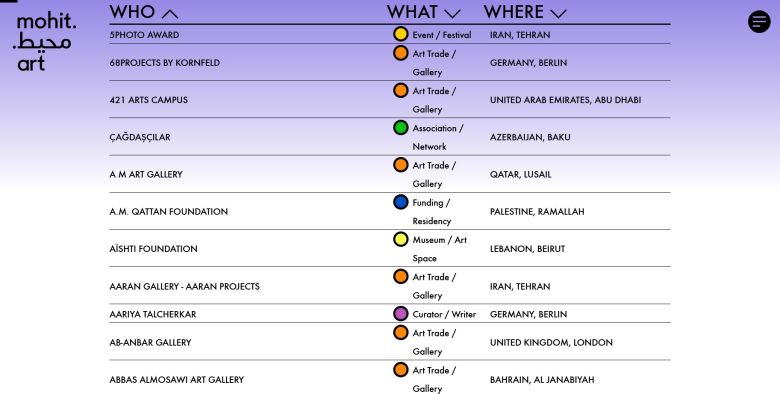
mohit.art supports the voices of artists, cultural actors and organizations from Southwest Asia and North Africa (SWANA) and their diasporas precisely at a moment when they are increasingly threatened . That is why we are now growing and transforming the mohit.art NETWORK — not simply by adding entries but by changing how the network works. The NETWORK is conceived as an increasingly participatory infrastructure in which artists, cultural practitioners and institutions can contribute more directly to its development and growth.
mohit.art remains the only organization building a curated, open-access network that connects artists, collectives, curators, writers, galleries, festivals, associations, and supporting individuals from SWANA and its diasporas. We are not simply publishing content: the NETWORK is intended to create greater visibility, access and participation across the cultural field.
Refusing silence, our response to the machinery of war is the daily work of taking up roles that expand “mohit” — the field that surrounds, connects, and sustains. Each profile on the NETWORK is a declaration of presence, each new entry, a tactic against fragmentation.
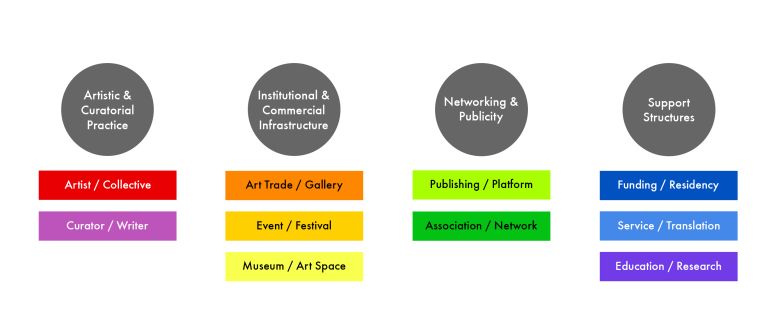
The mohit.art NETWORK is structured as a tool for solidarity and visibility. It maps ten kinds of artistic and cultural work across four primary domains: Artistic & Curatorial Practice, Institutional & Commercial Infrastructure, Networking & Publicity, and Support Structures.
Mapping the arts is not an abstract classification — it is a political act . We center not only artists but also those in the art field who write, research, translate, publish, host, fund, sell, collect and sustain. Cultural ecosystems do not endure through creativity alone; they rely on care, access, and shared tools.
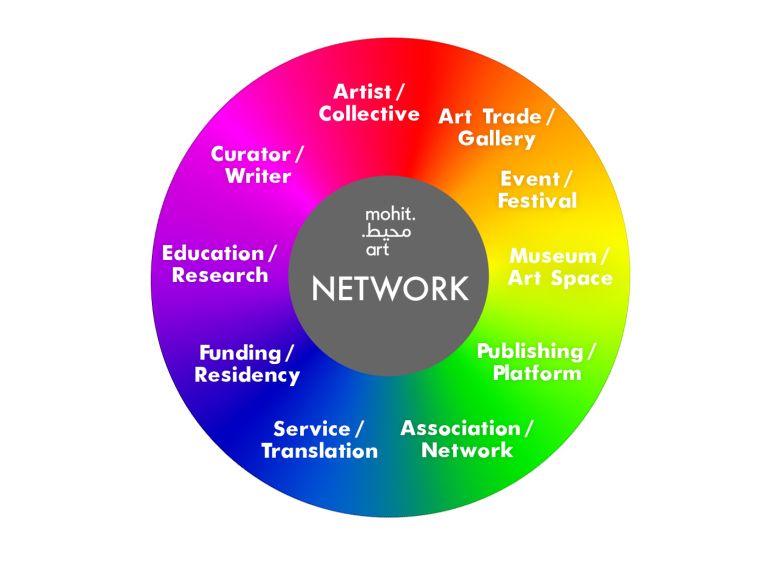
The NETWORK reflects the interdependence of contemporary cultural ecosystems. Artists, curators, writers, galleries, institutions, publishers, funders and residency programmes appear not as isolated categories but as overlapping parts of a shared field.
Each category is color-coded with intent — not to sort, but to connect. Artists who teach, curators who write, collectives that fund: all find space here. The structure reflects a field shaped by urgency, collaboration, and transcultural presence.
In today’s art field, institutional and commercial infrastructures have the most visibility — especially in the gallery and art-trade sectors. These are followed closely by museums and art spaces, alongside a strong community of independent artists and collectives.
Associations and networks act as key connectors across regions and practices. Funding bodies and residency programs form another crucial pillar, shaping mobility, time, and sustainability.
This diverse, interdependent ecosystem — crossing people, places, institutions, and platforms — gives the mohit.art NETWORK both its form and its force. It is not only a reflection of how art is made public but a blueprint for cultural survival and solidarity, practiced every day.
mohit.art is developing ways to combine open access with additional visibility options for artists, initiatives and institutions. The basic principle remains unchanged: access to the NETWORK should not depend on financial means. Additional services and presentation formats may be introduced step by step as technical and financial resources allow.
The mohit.art NETWORK first took shape in 2021 through strong participation from members in Germany, France, the Netherlands, and other parts of Europe alongside a dense constellation of artists, institutions, and initiatives from Iran. These starting points were not arbitrary but responded to overlapping urgencies: exile, repression, diaspora, and creative resistance.
From this foundation, the NETWORK has expanded across Southwest Asia and North Africa, with growing participation from Lebanon, Iraq, the Gulf region and other parts of SWANA, as well as diasporic contexts in Europe and beyond.
Further nodes are emerging: from Morocco and North Africa to diasporic initiatives in the Americas, especially in places where transcultural practices cross languages, affiliations, and borders.
The mohit.art NETWORK is intended to grow through the participation of artists, curators, collectives, galleries, museums and other cultural actors, while remaining curated and context-sensitive. This is not a top-down platform, but a shared space for visibility, continuity, and connection.
Yet openness does not mean anything goes. What makes the NETWORK meaningful is the quality of its content — the strength, rigor, and depth of the artistic and cultural work that fills it. The contemporary art scenes of Southwest Asia, North Africa, and their diasporas are often underrepresented — but they are not marginal in quality. Quite the opposite: they are intellectually bold, aesthetically rich, and deeply relevant to global discourse.
That is why participation in the NETWORK is based on a clear curatorial framework. Profiles are reviewed, and not all are accepted. All profiles are reviewed within a curatorial framework that considers artistic relevance, authorship, context and connection to the wider cultural field.
We welcome many languages, practices, and positions. But we ask that each entry shows artistic intent, authorship, and connection to a larger ecosystem. The NETWORK is a tool for shared presence — and quality is the key to its strength.
We continue to work toward a more participatory NETWORK in which members can take greater responsibility for their profiles and visibility as technical resources become available.
We see the mohit.art NETWORK as a cultural and political initiative in times of war, violence and forced migration. We build not to claim territory but to hold space: for those from and those working in SWANA between legitimacy and loss, in cultural environments shaped by fragmentation and urgency. The NETWORK is a who-is-who directory, but its also more: It becomes a strategy for resilience — a shared platform for presence — wherever it risks being erased. By extending the NETWORK, we build an important terrain of resistance through contemporary art — one that can’t be bombed, banned, buried, or forced to exile. This is our barricade against silence, a collective frontline.
The development of the mohit.art NETWORK has been made possible by a committed team and a growing network of regional collaborators.
The mohit.art NETWORK will continue to grow step by step. Our immediate focus is on strengthening its existing content, expanding regional representation and improving connections between artists, curators, institutions and other cultural actors. Further participatory and visibility tools will be developed as technical and financial resources become available.
We invite you to join.
REGISTER
network@mohit.art
